

Agentic AI is one of the most talked-about ideas in technology right now, yet most explanations bury it in jargon. Here is what it actually means, in plain language, with real examples you can relate to.
If you have only used AI as a chatbot, agentic AI is the next step: software that doesn’t just answer you, but gets things done. No technical background is needed to follow along.
What Is Agentic AI? The Simple Definition
Regular AI chatbots work like a question and answer machine. You ask something, it answers, and that’s the end unless you ask a follow-up.
Agentic AI works differently. Give it a goal, and it can break that goal into smaller steps, use tools on its own (like a web browser or a spreadsheet), check its own work, and keep going without you guiding every move.
Think of a chatbot as a smart friend you text a question. Agentic AI is more like handing that friend a task, such as “book me a flight and hotel for next weekend,” and letting them handle the steps. They check in only when they need a decision from you.
How Agentic AI Works: Plan, Act, Check
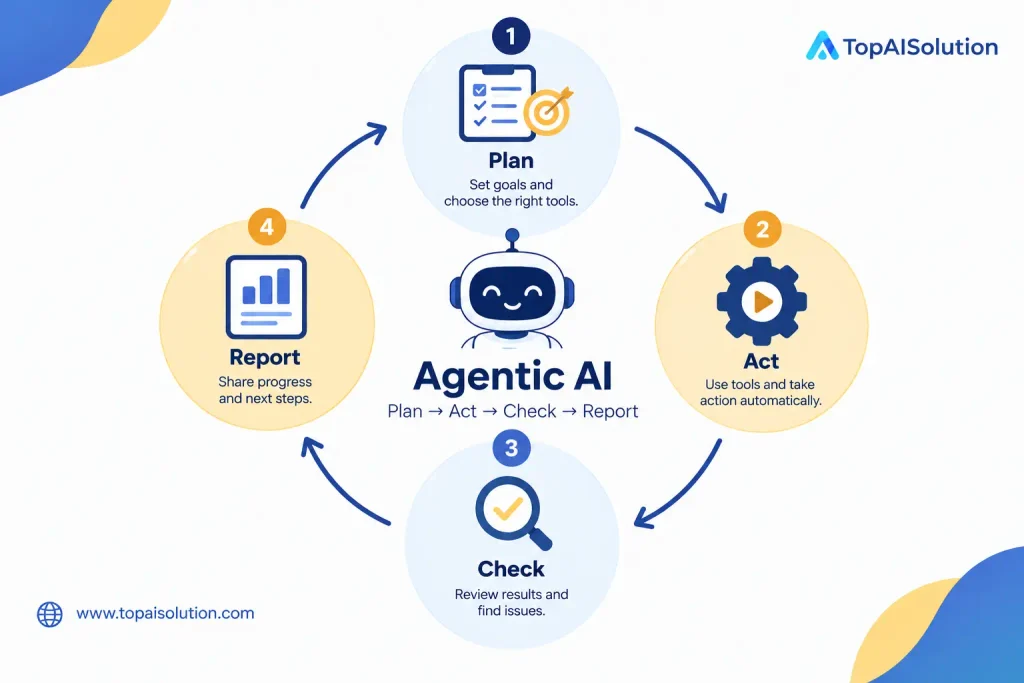
Most of these systems follow the same basic loop:
- Plan: the AI turns your goal into a list of steps
- Act: it uses tools such as search, email, a calendar or a code editor to carry out each step
- Check: it reviews the result, fixes mistakes, and decides what to do next
- Report: it comes back with the finished work, or asks for your approval
This loop is what separates agentic AI from a single question and answer exchange. The AI is not just generating text. It’s making decisions along the way.
Agentic AI vs. a Regular Chatbot
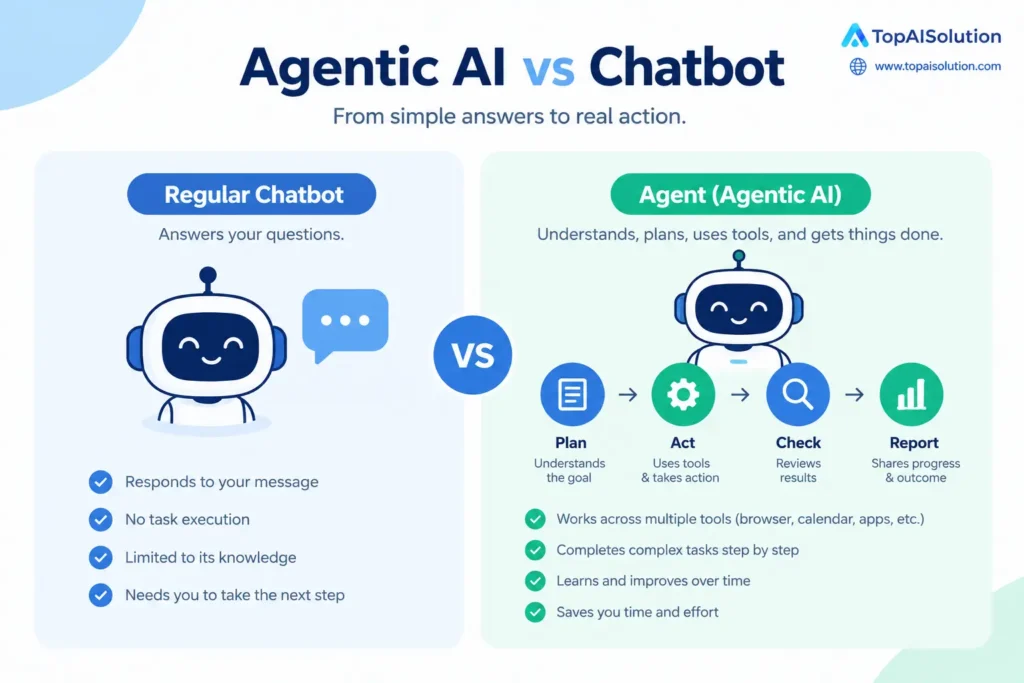
- Chatbot: answers one question at a time. AI agent: works toward a goal across many steps.
- Chatbot: relies on what it already knows or what you paste in. AI agent: can use outside tools like the web, files and apps.
- Chatbot: you guide every step. AI agent: plans and adjusts on its own, checking in when needed.
If you want to compare the assistants behind these tools, see our breakdown of ChatGPT vs Claude vs Gemini.
Real-World Examples of Agentic AI
Suppose you ask an AI to “research the top five competitors in my industry and summarize their pricing.” A traditional chatbot gives you a general answer from what it already knows. An AI agent can actually search the web, open competitor sites, pull out the real pricing, organize it into a table and hand you a summary.
Other everyday examples include:
- A coding assistant that reads your project, edits several files and runs tests to confirm the fix works
- A customer support agent that looks up an order, issues a refund and replies to the customer
- A research assistant that gathers sources across many pages and drafts a report
- A scheduling agent that checks calendars and books a meeting for you
Why Everyone Is Talking About AI Agents Right Now
The major AI labs have shifted their focus toward agents: models built to plan, use tools and work for longer stretches on their own. Businesses are adopting agentic AI to automate research, coding, customer support and scheduling.
There’s a catch, though. These systems take many steps (and use many tokens) to finish a single task, so costs can climb quickly if an agent is left running unchecked. Some companies have reported pulling back on early experiments after unexpectedly large usage bills, which is a big reason the industry is racing to make agent models cheaper to run.
Is It Safe to Use AI Agents?
For everyday tasks like research, writing, scheduling and coding help, agentic AI tools from major providers usually ask for your confirmation before they send an email, make a purchase or change a file. Still, an AI that acts on its own deserves a little more care than one that only talks.
A few sensible habits:
- Review the permissions before you connect email, calendars or files
- Start with low-stakes tasks until you see how the tool behaves
- Check the result before anything is sent or published, since agents can still make mistakes
- Keep sensitive accounts, like banking, out of early experiments
How to Try an AI Agent Yourself
You don’t need to code. Many agentic AI features are built into assistants you may already use, such as ChatGPT and Claude, where you simply describe a task in plain language.
If you want to build your own simple agent, our guide to the best AI agent platforms for beginners covers free, no-code options. And because clear instructions make any agent perform better, our tips on how to write better ChatGPT prompts apply here too.
Frequently Asked Questions
Not exactly. A chatbot answers one question at a time. An AI agent can plan and carry out multiple steps toward a goal, often using outside tools along the way, with less need for you to guide each step.
Researching a topic across many sources and summarizing it, automating a multi-step coding task, or handling a customer support request that involves looking something up and taking an action, all without a person directing each step.
These systems can take many steps and use many tokens to complete a single task, so usage costs can add up quickly if they run unmonitored.
It raises legitimate questions about oversight, since a system that acts more independently needs clearer safeguards. For everyday use, reviewing permissions and checking results before anything is sent keeps the risk low.
No. Most consumer-facing AI agent tools are used through a normal chat window. You describe the task, and the tool handles the technical steps behind the scenes.
1 thought on “What Is Agentic AI? Explained Simply for Beginners”
Comments are closed.