

Most people only get about 20% of what ChatGPT is actually capable of. They type a vague question, get a vague answer, and assume that’s just how it works. But the real issue usually is not ChatGPT, it’s the prompt.
Better ChatGPT prompts lead to noticeably better answers. Feed it a clear, detailed request, and you will get professional quality output that saves you real time. Feed it something vague, and you will get something vague back.
This guide breaks down 7 simple techniques for writing prompts that actually work whether you are using ChatGPT for writing, brainstorming, coding, or everyday problem solving.
What Makes a Good Prompt?
Before the tactics, let’s cover the basics. A strong prompt usually has three ingredients:
- Context: Who should ChatGPT act as, and what’s the situation?
- Specificity What exactly do you want, in as much detail as possible?
- Format: How should the answer be structured?
Nail these three elements, and you have already written a better ChatGPT prompts than most people ever will.
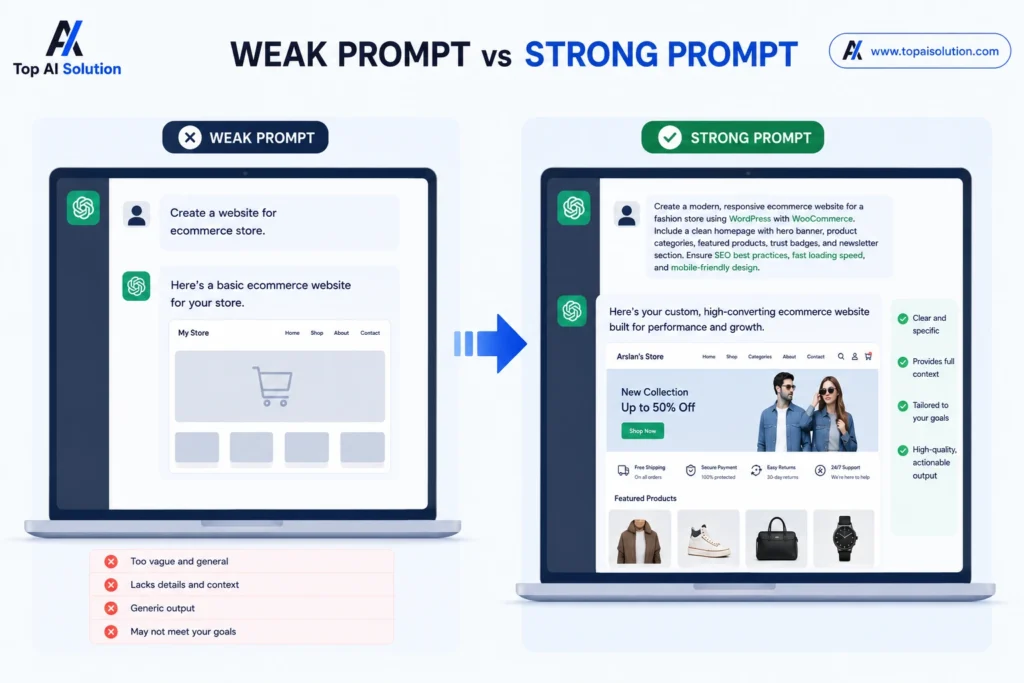
A weak prompt sounds like: “Write a blog post about AI.”
A strong one sounds like: “Write a 1,000 word blog post for small business owners about how AI can automate customer service. Use a friendly, conversational tone. Include 3 real examples. Structure it with an intro, three sections with subheadings, and a conclusion with a call to action.”
The second version gives ChatGPT a full brief instead of a vague idea and that’s the whole game.
7 Techniques for Writing Better ChatGPT Prompts
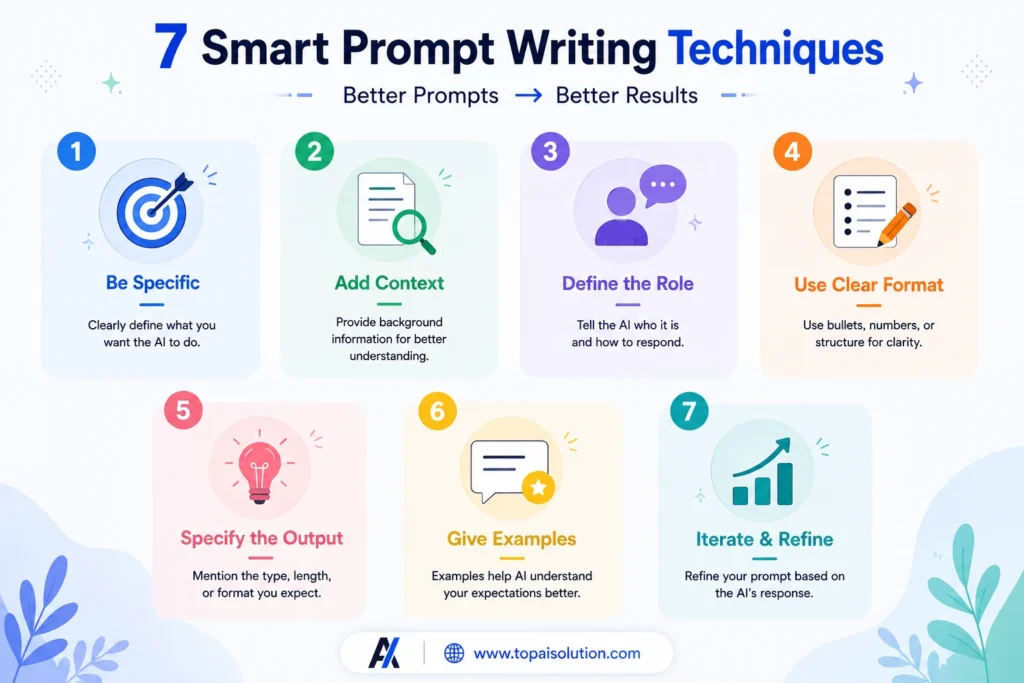
1. Give It a Role
The easiest win: tell ChatGPT who to be before asking your question.
Instead of: “Explain cryptocurrency”
Try: “You are a financial advisor with 10 years of experience explaining complex topics to beginners. Explain cryptocurrency to someone who is never heard of it.”
Assigning a role changes the tone, vocabulary, and depth of the response. A financial advisor explains differently than a computer scientist would. A teacher explains differently than a CEO.
Example: Ask for “an expert e-commerce copywriter” instead of just “write a product description,” and you will get sharper, more persuasive copy almost every time.
2. Be Painfully Specific
Vague requests get vague answers. Specificity is the single biggest lever you have.
Instead of: “Give me some productivity tips”
Try: “Give me 5 specific, actionable productivity tips I can use in the next 48 hours. Each should be 2–3 sentences with one concrete example.”
Add details like:
- How many: Items you want (not “some”)
- What format: Bullets, a table, paragraphs
- What tone: Professional, casual, playful
- What length: A sentence, a paragraph, 1,000 words
The more you specify, the less back and forth you will need afterward. This one habit alone can turn a mediocre ChatGPT prompts into one that gets exactly what you need.
3. Name Your Audience
Tell ChatGPT who is reading the answer, and it adjusts complexity automatically.
Explaining machine learning to a 10 year old versus a software engineer produces two completely different and equally useful answers. Try adding lines like:
- “Write this for small business owners with no technical background”
- “Write this for developers already familiar with Python”
- “Explain this to someone who’s never heard of the topic before”
This one habit alone tends to noticeably sharpen your results.
4. Ask for a Specific Structure
Don’t leave formatting to chance spell it out.
Instead of: “Write a social media strategy”
Try: “Write a 30-day social media strategy with: (1) Week 1 goals, (2) post ideas per platform, (3) a posting schedule, (4) engagement tactics, (5) success metrics, use bullet points for each section.”
You can request tables, numbered steps, before/after comparisons, or headings and subheadings. Telling ChatGPT the shape of the answer saves you from rewriting it yourself later.
5. Show, Don’t Just Tell
Giving an example of the tone or format you want is one of the most underrated techniques out there.
Instead of: “Write in a friendly tone”
Try: “Write in a friendly tone. Here’is an example of the style I like: ‘Hey! So you want to learn about cryptocurrency? Great question! think of Bitcoin like digital cash that lives on the internet, no bank required.'”
You can show an example output, a tone, a structure, or even link to something similar you liked. ChatGPT picks up on patterns fast.
6. Refine Instead of Restarting
The first answer is rarely perfect and that’s fine. Rather than deleting and starting over, build on it:
- “Write a blog intro about AI for small businesses”
- “Make it shorter, and add a hook at the start”
- “Make the tone more conversational, less corporate”
- “Add one real business example”
Each round gets you closer to what you actually needed, and it is much faster than starting fresh every time.
7. Add Constraints on Purpose
Limitations often push ChatGPT toward more creative, focused answers.
- “Do this without using the word ‘very'”
- “Keep it under 50 words”
- “Explain it like I’m five years old”
- “Give me 10 ideas, but all under $10”
Constraints force sharper thinking, try adding one to your next prompt and see what happens.
A Few Real Examples
Here’s the difference between weak and strong ChatGPT prompts in practice:
Weak: “Write a blog post intro about remote work”
Strong: “Write a 150-word intro for a business blog about remote work, aimed at small business owners considering it for the first time. Reassuring, conversational tone. Open with a hook addressing their biggest fear, losing productivity and include one supporting statistic.”
Weak: “Write a Twitter post about AI”
Strong: “Write 3 Twitter posts about AI helping small businesses, each under 280 characters, friendly tone, one emoji each. Vary them, one a question, one a stat, one a quick story.”
Weak: “Give me business ideas”
Strong: “Give me 5 business ideas that cost under $500 to start, can run part-time, use AI tools somehow, and target small business owners. Explain each model in 2 sentences plus the one AI tool it depends on.”
Common Mistakes People Make Writing ChatGPT Prompts
Even with good intentions, a few habits quietly sabotage results:
Being too vague. Don’t assume ChatGPT can read your mind spell out what you actually want.
Asking for too much at once. A prompt with ten requests gets ten half finished answers. Split big asks into two or three focused prompts instead.
Skipping context. ChatGPT does not know your business, your audience, or your goal unless you tell it. A sentence of context goes a long way.
Not proofreading the prompt itself. Typos and unclear phrasing confuse ChatGPT just like they’d confuse a person, read it back before hitting enter.
Treating the first answer as final. The real skill in getting good ChatGPT prompts to work for you is refining, not accepting the first draft as done.
Asking it to do what it’s bad at. ChatGPT can stumble on very recent events, exact calculations, and live pricing, know where its limits are.
A Few Habits for Writing Better ChatGPT Prompts
- Save the prompts that worked. Keep a running doc of your best ones and reuse them with small tweaks.
- Test variations. Try the same request with a different role, format, or constraint and compare.
- Use the conversation, not just a single message. ChatGPT remembers earlier context in the same chat, use that to refine as you go.
- Be polite. Oddly enough, adding “please” and “thank you” tends to nudge tone in a good direction.
- Iterate rather than restart. Small follow ups are almost always faster than deleting everything and beginning again.
Frequently Asked Questions
Clear context, specific detail, and a defined format. The more specific you are about what you want and how you want it, the better the response.
There is no ideal length. A prompt can be one sentence or one paragraph. What matters is clarity and specificity, not word count. A 20 word prompt that’s crystal clear beats a 100 word rambling one.
Yes, slightly the details change based on the task, but the underlying framework (context, specificity, format) stays the same across all of them.
Yes, actually. You can ask ChatGPT itself to improve your prompts. Example: “I want to ask ChatGPT to write X. Help me write a better prompt for that.” ChatGPT is good at meta analysis like this.
Read it out loud. Does it sound clear? Would another person understand exactly what you’re asking for? If yes, ChatGPT will too.
Next Steps: Start Writing Better ChatGPT Prompts Today
You don’t need all seven techniques at once. Start with just one giving ChatGPT a role and notice the difference in your very next conversation. Add another technique the following week, and within a month you’ll be getting noticeably sharper, more useful answers.
Once you have got the basics down, it’s worth exploring how the same principles carry over into other AI tools like the free image generators in our Top 10 Free AI Image Generators for Beginners guide, or the everyday tools covered in our Best AI Tools for Small Businesses roundup.