


Gemini 4 Hydrogen gives small teams another reason to reassess how they use AI for coding, research, and routine work. The useful question is whether it improves a task you actually perform, after review time, tool calls, and mistakes are included. A fast demonstration is a starting point for evaluation, not a migration plan.
Google announced the model on November 12, 2026; its launch page was updated November 16. This guide separates the announcement from an original model evaluation checklist for freelancers, agencies, and small businesses. The sample tasks and calculations below are illustrative. We have not run hands-on benchmarks or measured the model against competing products.
What Google announced
In its official launch announcement, Google positions Hydrogen as an execution-focused model for coding and agentic work. It lists access through AI Studio, the Gemini API, Gemini for business, the Gemini app, Search, and paid Pro or Ultra access in Antigravity. Product-specific terms still matter.
The announced API rates are $1.50 per million input tokens and $7.50 per million output tokens, with flat pricing across a one-million-token context window. These are model-token rates, not a quote for a complete automated workflow. Check current billing documentation before committing a budget.
Google’s separate Search announcement describes global availability, improved handling of complex questions, broader retrieval of relevant links, and more visual responses. Those are Google’s claims. A polished search answer still needs source inspection, especially when dates, prices, or eligibility determine your decision.
1. Match Gemini 4 Hydrogen to one real job
Start with a task that recurs often enough for an improvement to matter. For a web developer, that could be diagnosing a small layout bug. For an editor, it could be comparing three approved reference documents. For a shop owner, it might be preparing a draft response from a current returns policy.
Write down the inputs, expected result, and unacceptable outcomes before opening the tool. “Improve my website” is difficult to judge. “Fix the mobile navigation overlap without changing desktop spacing” provides a clear boundary. Keep a copy of the original files so you can inspect exactly what changed.
Choose a task you can evaluate yourself. If you cannot tell whether the result is correct, the pilot may measure confidence and presentation instead of quality. Bring in the person who normally approves that work before expanding the scope.
Our guide to AI agents versus chatbots helps distinguish a text answer from a system that changes files or operates tools. Make that distinction explicit in the pilot: preparing a patch and deploying it are separate actions.
2. Confirm the product surface and account access
The same model name can appear in different products with different controls. Record whether your test uses the Gemini app, an API integration, or a development environment. Note the account tier, selected model where visible, and any displayed usage restrictions. This makes your results understandable later.
Do not infer that a feature is free, unlimited, or included in your existing subscription because the model is widely available. Check the account screen you are actually using. If a requested capability is missing, document that limitation rather than silently substituting a different workflow.
A small agency should also decide who owns the account and project. An experiment in one employee’s personal workspace may be useful for learning, but it is a poor foundation for a process colleagues must maintain. Keep trial data separate from production credentials and client records.
3. Estimate the cost of a finished task
Use the announced Gemini 4 Hydrogen pricing as one component of a worksheet. In a hypothetical API request with 20,000 input tokens and 4,000 output tokens, simple token arithmetic gives $0.03 for input and $0.03 for output: $0.06 combined. This excludes other charges, discounts, taxes, retries, and any additional billed work.
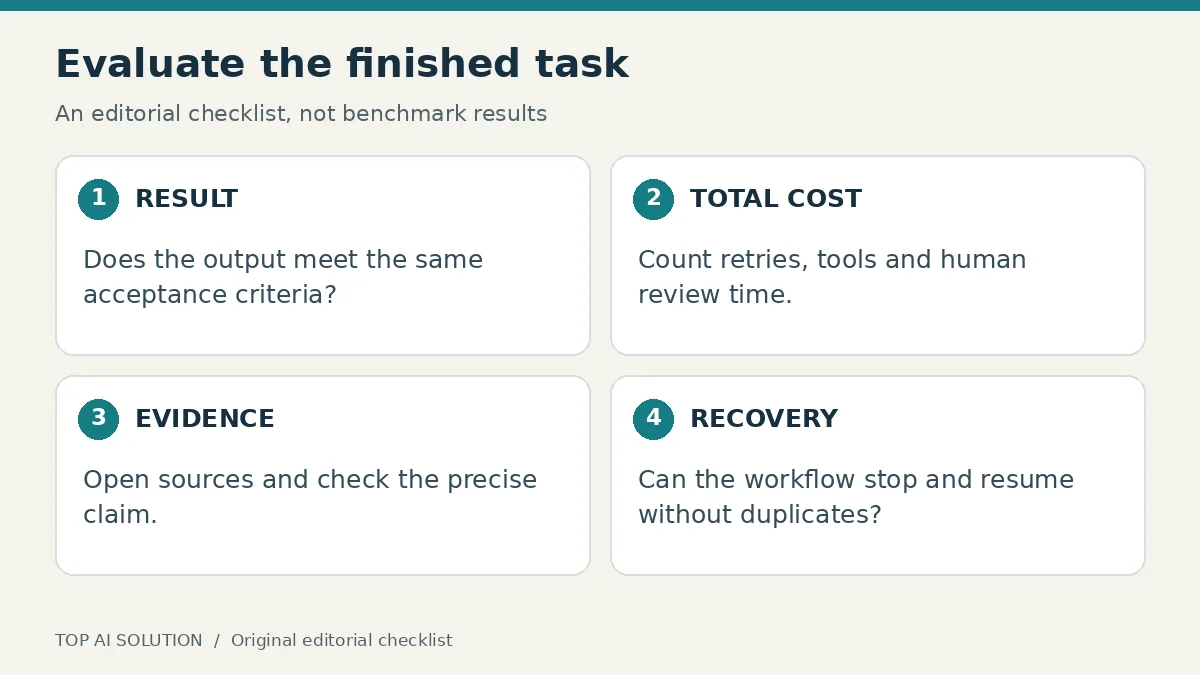
Now imagine the task needs three attempts and fifteen minutes of human correction. The token total alone would tell an incomplete story. Track attempts, external tools, reviewer time, and whether the final result was accepted. A cheap response that requires extensive repair can be an expensive deliverable.
Compare finished tasks rather than isolated replies. Create three columns: machine cost, human review time, and accepted outcome. If your product does not expose token-level billing, record the usage information it does provide without pretending it is an exact per-task price.
For recurring work, set a trial budget and a stopping rule before testing. For example, stop if repeated retries do not resolve the same failure. An agent should not keep exploring indefinitely merely because each individual request looks inexpensive.
4. Test Gemini 4 Hydrogen before measuring speed
Prepare a small evaluation set with ordinary, awkward, and incomplete inputs. A useful coding set could include a straightforward CSS issue, a bug with an unclear report, and a request that conflicts with a documented requirement. Include a task whose correct answer is to ask for missing information.
Keep the instructions and source files consistent when comparing tools. Record whether each answer meets the same acceptance criteria. For a code change, inspect the diff, run the relevant checks, and review the actual page. For research, open the supporting sources and verify the specific claims.
Measure elapsed time only after defining what completion means. Does the clock stop when text appears, when tests pass, or when a reviewer accepts the work? For most business decisions, the last of those is the useful measure.
Do not describe a five-task trial as proof that one model is universally better. Small samples help you decide whether to continue testing. They do not establish reliability across all languages, repositories, or business situations.
5. Inspect sources in AI-assisted Search
For Gemini 4 Hydrogen in Search, try a question with several practical constraints. An illustrative request might compare software options by supported file type, export format, and collaboration needs. Then check whether the answer addresses every constraint instead of merely producing a neat table.
Open the links behind the important rows. A source can be relevant to the general topic while failing to support the exact statement. Check whether a price is monthly or annual, whether a feature applies to the named plan, and whether the source describes a rollout or completed availability.
Keep a short evidence record: claim, supporting page, date checked, and unresolved uncertainty. If two official pages disagree, preserve that disagreement and seek clarification. Repeating the same search until an answer looks reassuring is not a reliable resolution method.
For website owners, this announcement alone does not establish a ranking change or guaranteed traffic opportunity. Continue making pages useful, specific, and easy to verify. Avoid rewriting a whole content strategy around an unmeasured assumption about how one model update will affect visits.
6. Limit actions and make failure recoverable
When Gemini 4 Hydrogen participates in an agent workflow, decide which actions require a reviewable proposal. Writing a draft, changing a local file, sending a customer message, and updating a live store have different consequences. A broad instruction to “finish the job” should not erase those boundaries.
Use a disposable test environment for the first trial. Give the system only the files and tools it needs. Test what happens when an input is missing, a service returns an error, or the requested action exceeds the agreed scope. The expected behavior should include a clear stop or escalation path.
Save enough information to understand the outcome: starting state, requested change, relevant actions, and final result. Avoid collecting unnecessary sensitive content in logs. Someone other than the original tester should be able to tell whether the task finished and what remains unresolved.
Our MCP tool security checklist offers a separate permissions review for workflows that use MCP connections. It does not certify a model; it helps you examine the access surrounding an agent.
7. Decide whether to adopt, narrow, or wait
After the pilot, classify each task as accepted, accepted with corrections, or failed. Write a short reason. “Changed unrelated files” is more useful than “bad at coding.” “Needed an updated source” points to a different fix from “ignored a clear requirement.”
Adopt the model for tasks where the evidence supports it. Narrow the scope where results are mixed. Wait where a missing capability or unreliable output prevents useful work. You do not need to move every workflow at once to benefit from one successful use case.
A practical rollout record names the task, owner, approved inputs, review step, cost boundary, and date for reassessment. Recheck after material product changes or repeated failures. Preserve a workable alternative so a temporary access issue does not stop the entire business process.
Conclusion
Gemini 4 Hydrogen is worth evaluating through a small, repeatable task with clear acceptance criteria. Separate the access question from the cost question, and both from correctness. A useful adoption decision comes from a result you can inspect, reproduce, and maintain—not from a model name or an impressive first answer.
Frequently asked questions
When was Gemini 4 Hydrogen announced?
Google’s launch article is dated November 12, 2026 and shows a November 16 update. Those dates describe the source; they are not evidence that every account has identical features or limits.
Does API pricing cover a complete agent workflow?
No. Model-token charges are only part of the possible cost. Include retries, external services, infrastructure, and human review when estimating the cost of an accepted result.
Should I replace my current coding tool immediately?
Run a limited comparison first. Use the same task, files, and acceptance criteria, then inspect the changes and test results. Keep the existing workflow available until the new one proves useful for your needs.
Does a citation guarantee an accurate Search answer?
No. Open the linked page and check that it supports the specific statement, including the relevant date, plan, region, or condition. A relevant link is not automatically sufficient evidence.
Are the examples in this guide benchmark results?
No. They are suggested evaluation exercises and illustrative arithmetic. This article does not claim hands-on testing, measured speed improvements, or guaranteed savings.