
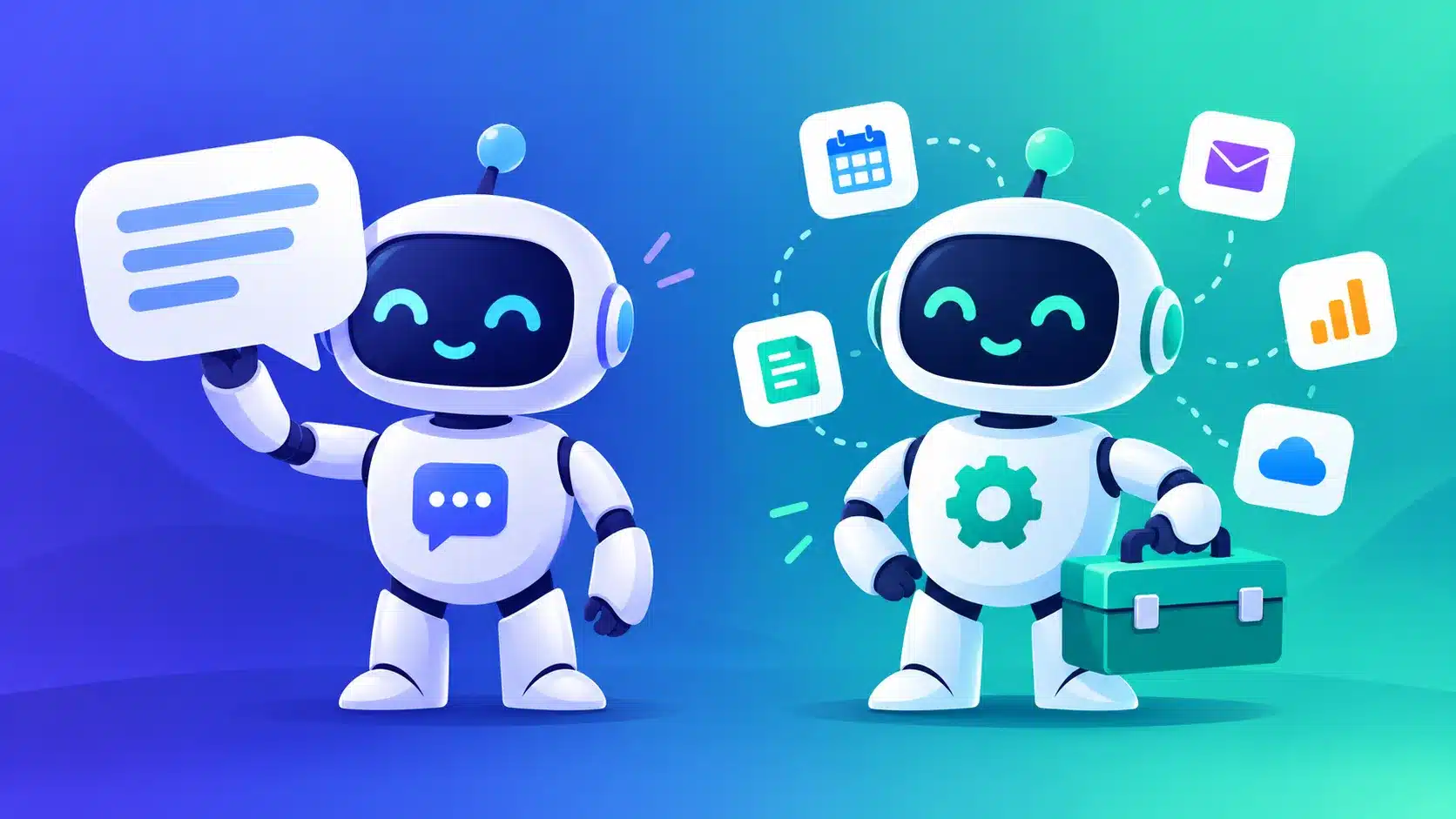

AI agents and chatbots get mixed up constantly, and vendors make it worse: many products sold as “agents” are really chatbots with a new label. The short version is that a chatbot talks, while an agent acts. This guide explains the difference in plain English, shows where each one fits, and gives you a checklist for spotting the hype.
If you want the background first, start with our explainer on what agentic AI is. This article focuses on a different question: which one do you actually need?
The Short Answer: AI Agents vs Chatbots
A chatbot responds to what you say. AI agents take a goal, work out the steps, use tools to carry them out, and check the result. The difference is not how smart the AI sounds. It is whether the system can do things beyond writing text.
| Chatbot | AI agent | |
|---|---|---|
| Main job | Answer questions | Complete tasks |
| How it works | Replies to each message | Plans steps toward a goal |
| Uses outside tools? | Rarely | Yes (search, email, calendar, code) |
| Needs you for each step? | Yes | Mostly no, with approvals for key actions |
| Risk if wrong | A bad answer | A bad action |
| Cost and setup | Lower and simpler | Higher and more complex |
| Best for | FAQs, simple support | Multi-step, repeatable workflows |
What Is a Chatbot?
A chatbot is software you talk to. There are two main kinds:
- Rule-based chatbots follow scripts and decision trees. They handle the questions someone planned for and hand off the rest.
- AI chatbots use a language model, so they understand varied phrasing and write natural replies. ChatGPT-style assistants fall here.
Both are reactive. They wait for your message and respond. If you want one for your own site, our guide to building an AI chatbot without coding walks through it.
What Are AI Agents?
AI agents are systems that work toward a goal on their own. You describe the outcome, and the agent breaks it into steps, uses tools to carry them out, checks its own work and adjusts. A good agent also pauses to ask for approval before risky actions, such as sending an email or spending money.
Think of a chatbot as someone who answers your questions at a help desk. An agent is more like an assistant you hand a task to.
A Spectrum, Not Two Boxes
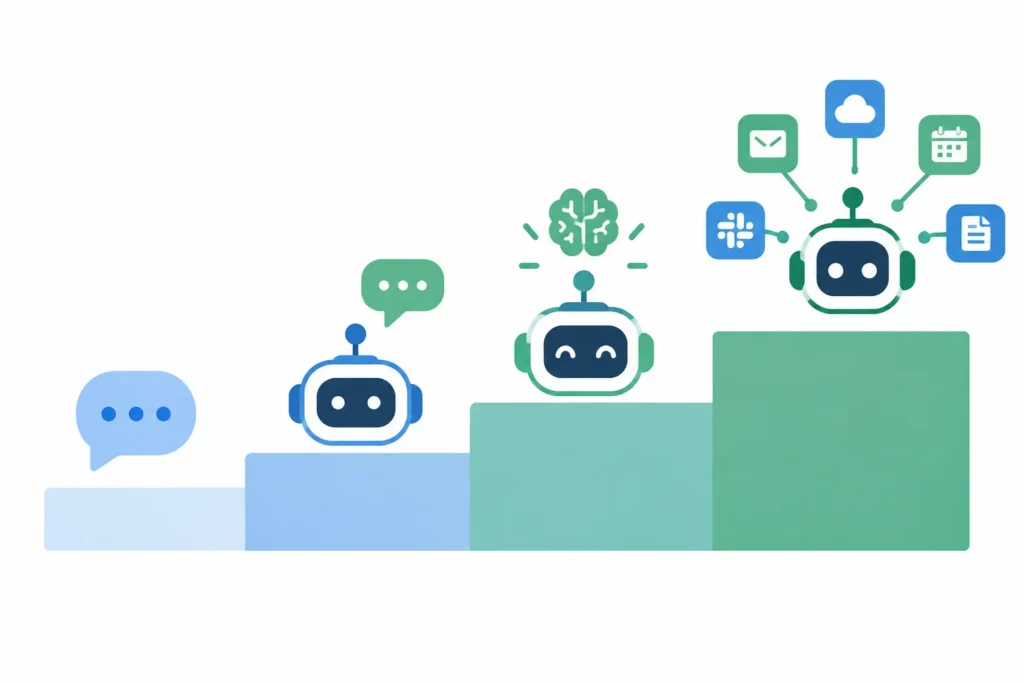
In practice, the line is blurry. It helps to picture four levels:
- Rule-based chatbot: follows a script.
- AI chatbot: understands and writes natural language, but mostly just answers.
- AI assistant with tools: can look something up or complete one action when asked.
- AI agents: handle multi-step tasks toward a goal, using several tools.
Assistants such as ChatGPT and Claude can sit at level 2 or 3, and in some modes they work like agents. Most products you’ll meet today fall in the middle, which is why labels can be misleading.
Real Examples: The Same Task, Two Approaches
- Customer support. A chatbot answers “where is my order?” with a tracking link or hands you to a person. AI agents can look up the order, check the return policy, issue a refund within set limits and email you the confirmation.
- Scheduling. A chatbot suggests meeting times. An agent checks everyone’s calendars and books the slot.
- Coding. A chatbot writes a snippet. An agent edits several files, runs the tests and fixes the errors.
- Research. A chatbot summarizes what it already knows. An agent searches several pages, pulls out the facts and builds a comparison table.
When to Use a Chatbot, and When to Use AI Agents
Choose a chatbot when:
- Questions are simple, repetitive and predictable
- You want something cheap, quick to set up and easy to control
- A wrong answer is annoying but not costly
Choose AI agents when:
- The task has several steps across different apps
- The same workflow repeats often enough to be worth automating
- You can set clear limits and review the results
AI agents come with trade-offs. They can use many steps (and many tokens) per task, so costs can climb. They also need permissions to act, so mistakes can have real consequences. Start with low-stakes tasks and keep a human approval step for anything important.
Watch Out for “Agent Washing”
Because “agent” is a hot label, plenty of vendors stick it on ordinary products. Analyst firm Gartner called this “agent washing” in a June 2025 forecast. It described vendors rebranding chatbots, assistants and older automation tools without real agent abilities, and estimated that only about 130 of the thousands of agentic AI vendors were genuine.
The same forecast predicted that more than 40% of agentic AI projects will be canceled by the end of 2027, citing rising costs, unclear business value and weak risk controls. Gartner’s advice was to use agents only where they deliver clear value. You can read the details in Gartner’s press release.
Before you buy anything labeled an agent, ask:
- Can it take actions in other apps, or does it only reply with text?
- Does it plan several steps, or answer one message at a time?
- What happens when it’s wrong? Look for approvals, limits and activity logs.
- What does it cost per task, not just per month?
If the answer to the first question is no, you are looking at a chatbot.
How to Try Both for Free
You can test the difference yourself this week. Build a simple chatbot with a free no-code tool, then try one of the best AI agent platforms for beginners on one small, repeatable task. That hands-on test is the fastest way to understand AI agents. Clear instructions help both, so our tips on how to write better ChatGPT prompts apply to either.
Frequently Asked Questions
Not quite. The difference is structural. A chatbot replies to messages, while AI agents plan multi-step work and use tools to act on it. A very smart chatbot is still a chatbot if it can’t take actions.
Mainly a chatbot, but it depends on the feature. When it only answers questions, it works as a chatbot. When it browses, runs code or carries out multi-step tasks for you, it behaves more like an agent.
Not always. Chatbots are simpler, cheaper and easier to control, which makes them the better choice for FAQs and predictable support questions. Agents pay off when a task has many steps.
They can be, with limits. Review the permissions you grant, start with low-stakes tasks, and keep human approval for anything that sends, spends or deletes.
Most small businesses should start with a chatbot or a simple automation. Add an agent when you have a repeatable multi-step workflow, such as lead follow-up or report building, that is worth the extra cost and setup.