


ChatGPT healthcare agents are moving the discussion beyond answering questions toward preparing work across existing software. For an operations team, that raises a practical question: which steps can an assistant prepare reliably, and which decisions must remain with an accountable person? The answer depends on the workflow, access controls, and review process surrounding the system.
On November 16, 2026, OpenAI announced advances in computer-use agents for healthcare alongside clinical-search improvements and an expanded plugin ecosystem. This article explains the technology announcement and proposes an administrative pilot checklist. It is not medical advice, a compliance determination, or a report of our own clinical testing. The fictional examples use invented data and avoid treatment decisions.
What changed in the announcement
OpenAI’s healthcare announcement introduces computer-use capabilities, improved clinical search, and more than twenty new healthcare plugins. It describes access subject to workspace settings and directs organizations to sales for purchasing. Individual Clinicians access has eligibility and geographic conditions; ordinary consumer access should not be assumed equivalent.
The companion computer-use article describes agents navigating software through clicking and typing, and presents a demonstration with synthetic patient data. It also reports vendor evaluations and work with healthcare organizations. Those reports do not establish performance in your organization’s systems, patient population, or operating procedures.
The important distinction is between a generated suggestion and a change made in another application. Our introduction to AI agents versus chatbots explains that difference. In healthcare administration, the review process needs to make the distinction visible at every consequential step.
Why this matters for administrative teams
Many administrative tasks involve moving information between screens, checking whether a document is present, and preparing the next step. An assistant that operates software could reduce some of that manual handling. However, the value is not the number of clicks performed. It is whether the correct work reaches the right reviewer without introducing new errors.
Consider an invented referral-processing exercise. A team member has a referral form, a scheduling record, and a checklist of required attachments. A useful pilot might ask an assistant to identify missing items and prepare an internal review note. It should not silently infer a clinical conclusion or promise an appointment that nobody has approved.
This is an editorial example, not a description of a guaranteed product feature. The organization must verify what its selected deployment actually supports. Start with a workflow whose normal rules are documented and whose output can be checked by the responsible team.
1. Give ChatGPT healthcare agents a reviewable task
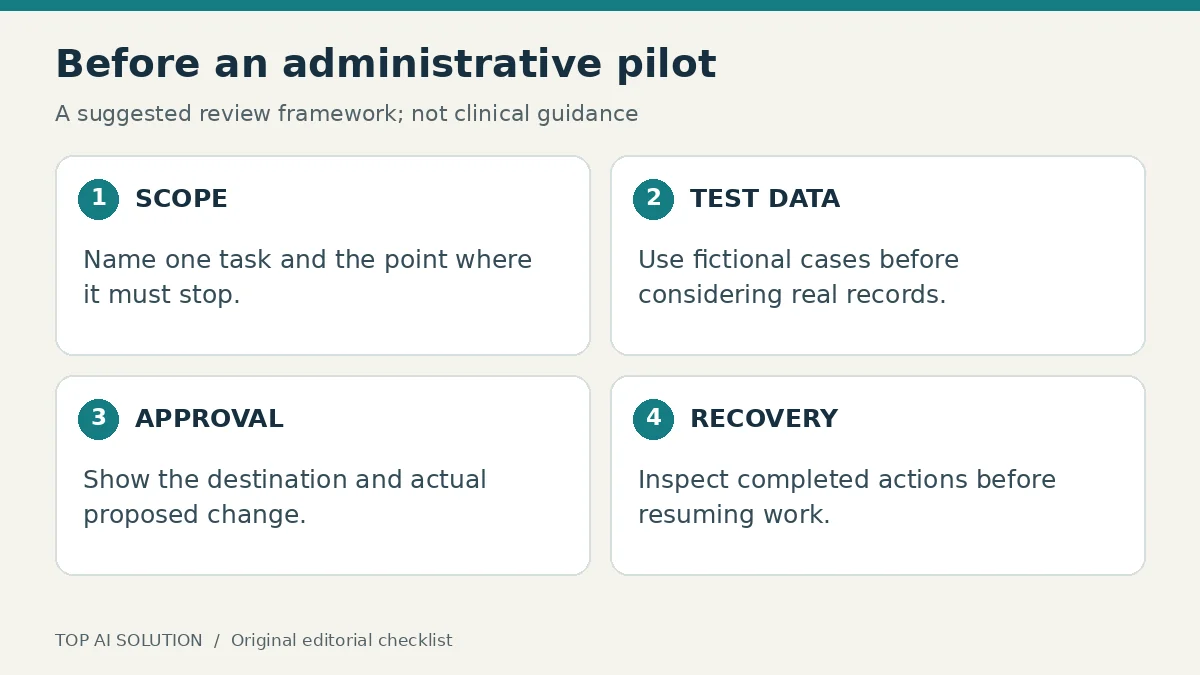
Write the pilot’s purpose in a single sentence. For example: prepare a missing-document checklist from a synthetic referral packet. Specify the permitted input documents, the required output, and the point where the assistant must stop. Avoid a broad instruction to manage a patient’s entire journey.
List the actions that are outside scope. In this example, those might include sending messages, altering appointments, submitting forms, or changing clinical records. The list should match the actual trial; it is not a universal rule for every deployment.
Name the reviewer and the escalation owner. If a document is unclear, who decides what it means? If access fails, who investigates? If the assistant stops halfway through, who checks whether any changes occurred? These responsibilities should be settled before the pilot begins.
2. Confirm the deployment and data boundary
OpenAI says healthcare use involving protected information requires eligible services and applicable contractual, security, retention, and connected-system protections. Its announcement also describes workspace controls and agreements. Treat those statements as starting points for your organization’s assessment, not a blanket assurance that any ChatGPT session is suitable.
For the first technical exercise, use clearly fictional records with no real patient identifiers. Match the structure of the task without copying confidential content into an unapproved environment. This lets the team examine workflow behavior before deciding whether a real-data pilot is appropriate.
Ask the responsible privacy, security, and operations teams to confirm the chosen setup. Record which systems are included, who administers access, and where outputs are stored. If the deployment boundary is unclear, resolve it before adding sensitive data. A successful demonstration does not answer those questions by itself.
3. Separate preparation, approval, and submission
ChatGPT healthcare agents should be evaluated at the boundary between preparing work and committing a change. A draft can be reviewed. A submitted form may trigger downstream actions. Your interface and procedure should make it clear which stage the workflow has reached.
A meaningful approval presents the actual destination and proposed content. The reviewer should be able to compare it with the relevant source, correct mistakes, and decline the action. A generic confirmation that hides the affected record provides little basis for judgment.
Test whether editing a draft changes the version that will be submitted. Also check what happens after a timeout or interrupted session. The team needs to know whether resuming will continue unfinished work or repeat an action that already succeeded. Repeated submissions can create more cleanup than the original manual task.
4. Build a practical evaluation set
Create a small collection of synthetic cases reflecting the workflow’s real variations. Include complete documentation, a missing attachment, a duplicated document, inconsistent dates, and an ambiguous identifier. Add a case that should be escalated rather than completed automatically.
For each case, write the expected result before running the assistant. A successful outcome might be a correct checklist with an explicit unresolved item. It should not require the model to invent information simply to fill every field.
Have the usual reviewer assess the output using the same criteria across all cases. Record missed information, incorrect additions, wrong destinations, unnecessary actions, and appropriate stops. Keep presentation quality separate from factual and operational correctness.
Repeat selected cases after changing a relevant input. A system that handles the original document well may behave differently when a file is renamed or a screen layout changes. This exercise is an acceptance test for your workflow, not a clinical validation study or proof of universal reliability.
5. Check the evidence behind each prepared field
For an administrative draft, ask where every important value came from. A document date, contact detail, or attachment status should be traceable to the approved input. If two documents disagree, the assistant should expose the conflict instead of selecting a convenient value without explanation.
Use a compact review table with the proposed value, source location, and unresolved question. The purpose is to help the reviewer check work efficiently. Do not create a large secondary copy of sensitive records merely to demonstrate that the assistant used them.
Where the task includes clinical information, the appropriate qualified professional remains responsible for its interpretation and use. This guide does not define a medical decision process. Keep an administrative pilot focused on its stated administrative purpose, and route clinical uncertainty through the organization’s established procedure.
6. Measure useful completion and recovery
Measure the time from starting a case to accepting the final output. Include reviewer corrections, retries, interruptions, and cleanup. A fast first draft may still increase workload if it requires extensive checking or creates inconsistent records.
Track how often the assistant correctly stops when information is missing. Treat that as a useful outcome when the task cannot be completed responsibly. An evaluation that rewards only filled forms can accidentally encourage unsupported assumptions.
Practice a controlled interruption with synthetic data. Stop the task, inspect the target system, and determine what is complete. Then resume through the approved procedure. Record whether the assistant recognizes existing work and avoids duplicates.
OpenAI’s published evaluation numbers should remain attributed to OpenAI and their stated conditions. They are not a substitute for measuring your own workflow. A reported benchmark cost is also not a quote for your deployment, integrations, review labor, or support arrangements.
7. Decide where ChatGPT healthcare agents fit
After testing ChatGPT healthcare agents, decide whether to continue, narrow the scope, or pause. A useful decision record includes the task, evaluated cases, observed failures, permitted actions, responsible reviewer, and the next review date. Keep unresolved items visible rather than burying them in a general positive summary.
Expand one boundary at a time. If the assistant reliably prepares a checklist, evaluate a separate draft-generation step before granting submission capability. Each added permission changes what can go wrong and what the reviewer needs to see.
Maintain a manual fallback and a clear way to stop further activity. Staff should know what to do when access disappears, a tool behaves unexpectedly, or the prepared output is inconsistent. Avoid making the pilot the only route through an essential process before it is adequately assessed.
For connected-tool workflows, our MCP tool security checklist covers general questions about permissions, operators, and stopping access. It is background reading, not healthcare-specific compliance guidance or evidence that every healthcare plugin uses MCP.
A useful first meeting agenda
Before requesting a demonstration, bring the workflow owner, reviewer, and technical administrator together around one sample case. Ask them to mark the steps that involve reading, drafting, approval, and external change. The resulting map often reveals unclear responsibilities before any automation is introduced.
Agree on what would make the pilot worthwhile. That might be fewer missing attachments or less time assembling a review packet. Avoid setting a success measure that requires the assistant to operate without oversight when oversight is part of the intended design.
Finish with a short list of unanswered product questions for the provider. Ask about the specific account, applications, permissions, and recovery behavior you need. Concrete questions produce a more useful evaluation than a general request to show everything an agent can do.
Conclusion
The ChatGPT healthcare agents announcement is significant because it concerns work performed across software, not only generated text. Evaluate that capability through a narrow administrative task, explicit review boundaries, synthetic cases, and a recoverable process. The useful outcome is dependable assistance that fits the team’s responsibilities—not autonomy for its own sake.
Frequently asked questions
When was the healthcare-agent expansion announced?
OpenAI published the healthcare expansion and companion computer-use article on November 16, 2026. Check the linked official pages and your workspace settings for the applicable access conditions.
Is a consumer ChatGPT account automatically suitable?
Do not assume that. The organization needs to verify the eligible service, account configuration, agreements, data handling, and connected systems for its intended use before introducing sensitive information.
What is a sensible first pilot?
A bounded administrative exercise using fictional records, such as preparing a missing-document checklist for human review, is easier to evaluate than an end-to-end process with external actions.
Do the published evaluations prove local reliability?
No. Vendor results apply to their reported evaluation conditions. Assess the actual workflow, inputs, interfaces, review requirements, and failure recovery in the intended deployment.
Does this article recommend clinical automation?
No. It proposes an administrative evaluation framework and reports a technology announcement. It does not recommend treatment decisions or replace qualified clinical, privacy, security, or organizational review.