


ChatGPT for Academic Researchers is expanding, with the next application round scheduled to open on November 23, 2026. For researchers considering it, the useful next step is to prepare an accurate application and a small, reviewable research task. Free access can reduce a software expense; it does not remove the need to check evidence, institutional permissions, and research quality.
This guide to ChatGPT for Academic Researchers separates the announced offer from our suggested preparation workflow. Sources were checked on November 17, 2026. The examples below are fictional planning exercises, not accounts of hands-on testing or measured research improvements.
What changed in the November announcement
In its November 16 announcement, OpenAI says the next round offers 50,000 new grants on a first-come, first-served basis to eligible applicants. Each covers the recipient and up to two collaborators with ChatGPT Plus access. The broader program aims to reach 200,000 researchers. That overall ambition should not be confused with the number of new grants in this round.
The practical implication is preparation, not a guaranteed place. Set aside time to read the application when it opens, check the terms shown for your own award, and keep a record of what you submit. Do not describe a waitlist registration as an accepted application.
Check the access route before planning a project
OpenAI’s researcher access guide distinguishes several programs. Here is a compact comparison, checked November 17. It is a navigation aid; current program terms and institutional agreements govern access.
| Route | Intended use | What to confirm |
|---|---|---|
| ChatGPT for Academic Researchers | Academic researchers and small research teams | Eligibility, sponsored seats, award dates; API credits are excluded |
| Researcher Access Program | Research into responsible AI, risks, or societal effects | API-credit application and project requirements; not ChatGPT seats |
| Institution-provided ChatGPT Edu | Research through an institution | Whether your campus offers a seat and which agreement applies |
| Rosalind Academic Plan | Eligible life-sciences labs at U.S. universities | Lab approval and separate trusted access for GPT-Rosalind |
Choose the route around the work. If your experiment requires repeatable API calls from code, a chat workspace alone does not establish that your computing costs are covered. If the department already provides an approved workspace, ask the administrator which route fits before creating a parallel arrangement.
ChatGPT for Academic Researchers eligibility: what to verify
The current Help Center guidance describes eligible research faculty and postdoctoral applicants, recent relevant publications, supported institutions and countries, and academic-research use. It lists scientific and engineering fields. Student eligibility as a collaborator is separate from eligibility to apply as the researcher owner. The current self-serve offer describes up to twelve months and eligible collaborators at the same institution; an approved award controls its actual terms.
The help page still describes new applications as closed, while the dated announcement specifies the upcoming round. These statements concern different times. Use the announcement for the planned opening date and recheck the live application then. The access guide also warns that final new-intake rules need confirmation. Do not assume every current detail automatically carries into the next round.
Make a private preparation note with your institutional email, current role, public affiliation page, and links to relevant publications. This is an editorial checklist, not a claim that the application demands every item. Accurate links are more useful than a long promotional description of your work.
Prepare one research task you can evaluate
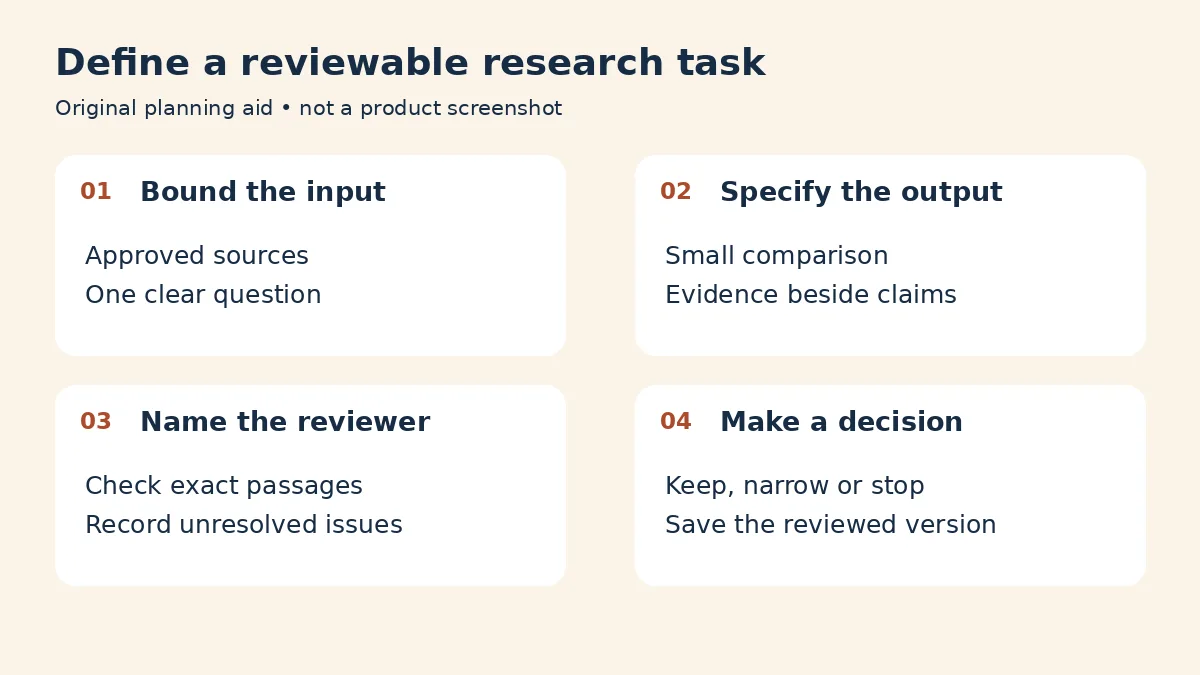
Before applying, write one sentence describing the first task you would attempt. Good candidates have a clear input, a limited output, and a human reviewer who can judge correctness. “Help organize terminology across these approved open papers” is easier to assess than “solve our entire research problem.”
For a fictional materials-science group, the first task could be extracting how five open papers define a measurement. The output should preserve the authors’ definitions, identify differences, and link each entry to its supporting passage. It should not invent a consensus or silently merge incompatible methods.
Define what the assistant may do and what remains with the researcher. It might draft a comparison structure or suggest questions. The researcher chooses inclusion criteria, reads the cited passages, and decides whether the comparison is scientifically meaningful. Record those responsibilities before the output arrives.
Use a small input set you already understand. Starting with familiar material makes errors easier to detect. Once the workflow is useful, you can expand carefully. A large unfamiliar document collection makes an impressive-looking answer harder to audit and can hide mistakes behind the cost of checking them.
Build an evidence ledger, not just a polished answer
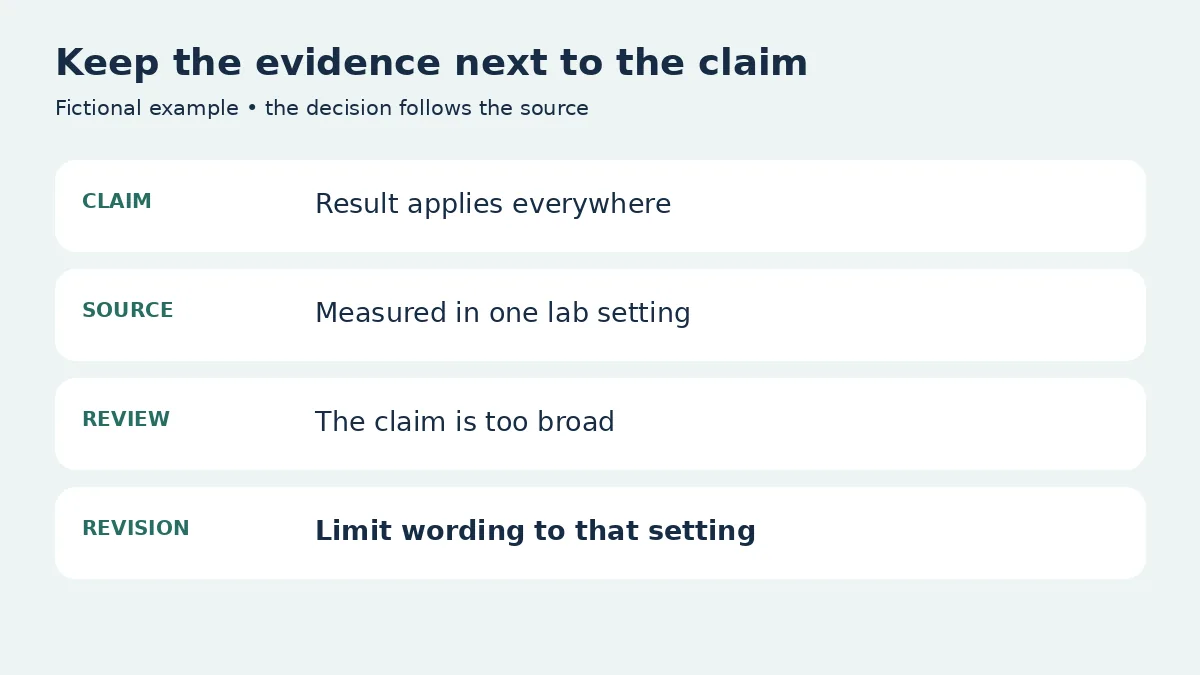
A simple evidence ledger keeps claims connected to source material. Give each proposed claim a source, a passage location, a reviewer, and a status. The status can be supported, qualified, or unresolved. A citation by itself is not a verdict: the cited passage must support the precise statement being made.
Consider a paper that measures performance in one laboratory setting. A draft may broaden that into a claim about all field conditions. The citation is relevant but the conclusion is too wide. Revise the statement to match the setting, or mark the broader proposition as a question for further investigation.
For a reusable request, try this original prompt:
Using the approved documents, draft a comparison of how each source defines the selected measurement. Keep author statements separate from your interpretation. For every factual entry, identify the document and passage. Flag inconsistent definitions and missing evidence. Do not invent a reference, infer an unreported result, or resolve a scientific disagreement without explaining the evidence.
This wording is a starting point, not a reliability guarantee. Our prompt-writing guide explains how specifying context and output structure helps make a request easier to review.
Decide whether your data belongs in this workspace
OpenAI says the researcher workspace’s content is not used for model training by default. That does not, by itself, authorize uploading a dataset. Institutional rules, consent conditions, contracts, and the permissions attached to the material still matter. Ask the responsible institutional contact when the appropriate data-handling route is unclear.
For the initial exercise, choose public, licensed, or synthetic material that you are allowed to process. Remove unrelated identifiers and internal comments. Keep a short note explaining why the selected input is suitable. This makes the pilot easier to review without pretending that one generic privacy label answers every research-governance question.
Separate operational convenience from scientific reproducibility. Keep the source version, task wording, date, and reviewed output in your project’s normal records. If a result contributes to an analysis, document enough context for a colleague to understand how it was obtained and checked. Follow your institution’s and target publication’s applicable disclosure requirements.
A practical first-week pilot
Use the first week to answer a narrow question: does this workflow produce a useful, checkable deliverable at an acceptable review cost? The plan below is our suggested evaluation approach, not an OpenAI requirement or an estimate of guaranteed savings.
| Stage | Work to do | Evidence to keep |
|---|---|---|
| Scope | Choose one task, approved inputs, and a reviewer | One-paragraph task brief |
| Baseline | Complete a small sample with your existing process | Expected answer and review notes |
| Assisted draft | Run the bounded request | Prompt, input versions, raw output |
| Verification | Inspect claims, calculations, and references | Corrections and unresolved issues |
| Decision | Keep, narrow, or stop the workflow | Reasons and a named owner |
Count review time as part of the work. A draft produced quickly can still be expensive if checking it requires rebuilding the analysis. Note the kinds of corrections required, such as missing qualifications, unsupported citations, or inappropriate aggregation. Different error types call for different remedies.
If the pilot fails, narrow it rather than asking for more confident prose. Perhaps terminology extraction works but synthesis does not. Perhaps the assistant helps structure an outline but should not supply factual content. A limited useful role is a valid outcome; the aim is dependable research support.
Plan collaboration and the end of the award
Choose collaborators for complementary responsibilities. One person might prepare inputs, another inspect evidence, and another review how the output will be used. Even in a small team, avoid leaving every check to whoever wrote the original request. A fresh reader often notices assumptions that the task owner no longer sees.
Keep project decisions in a shared place your institution approves. A chat history is useful working material, but a final research decision should identify the accepted output, its limitations, and who approved it. Make clear which files are drafts so a polished preliminary answer is not accidentally cited as a finding.
Before the award ends, review what the team needs to retain and what should be removed according to its policies. Maintain essential project records independently of the assistant. Reassess the workflow on its actual usefulness rather than continuing merely because the first access period was complimentary.
For teaching-related work, our guide to AI and academic integrity discusses why the permission for a task matters. Research, coursework, and assessment may follow different rules; confirm the one that applies to your situation.
Frequently asked questions
When does the next application round open?
OpenAI’s November 16 announcement schedules the next round for November 23, 2026. Recheck the official program page before applying; an announced opening is not confirmation that your application has been accepted.
Does the researcher offer include API credits?
The researcher access guide says this ChatGPT offer excludes API credits. If your project needs programmatic model calls, assess the separate API research route and its terms before budgeting the work.
What should a first research pilot produce?
Aim for a small deliverable with known inputs and a clear reviewer, such as a checked terminology comparison. Keep source passages and unresolved questions beside the draft so the result remains inspectable.
Can an AI-generated citation be trusted without opening it?
No. Open the referenced source and check that the passage supports the exact claim. A real reference can still be irrelevant, misread, outdated, or used to justify a conclusion broader than the evidence.
What is the most useful preparation before applying?
Prepare accurate affiliation and publication information, identify the appropriate access route, and define a modest task using permitted material. Read the live terms rather than assuming a prior award or someone else’s offer applies to you.
A useful next step
Prepare the application information and a one-page pilot brief now. When ChatGPT for Academic Researchers opens its next round, check the actual requirements and apply through the official route. For applicants, a bounded pilot and clear evidence trail offer a practical starting point. If accepted, start with evidence you can verify and expand only when the results justify it.