

Whether AI for homework counts as cheating depends less on the tool and more on how you use it and what your teacher allows. The short version: using AI to understand something is usually fine, handing in AI-made work as your own usually isn’t, and your school’s rules settle the gray area in between.
This guide gives you a simple way to judge AI for homework, how to disclose and cite it, and what to do if someone accuses you of cheating.
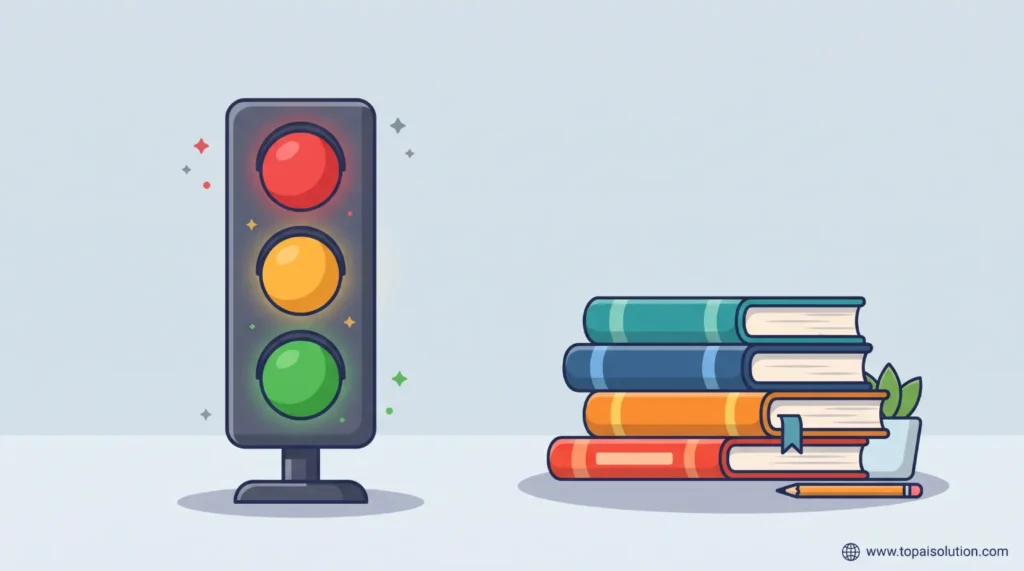
The Short Answer: A Traffic Light for AI for Homework
Usually fine (green) uses of AI for homework:
- Asking AI to explain a concept in simpler words
- Getting practice questions and quizzes on a topic
- Asking for hints when you’re stuck, after trying the problem yourself
- Checking grammar and clarity in writing you produced
- Brainstorming topic ideas
Ask first (yellow) uses of AI for homework:
- Having AI outline an essay or suggest a structure
- Letting AI rewrite sentences, not just flag problems
- Translating text, or getting help with code in a programming class
- Using AI on a take-home assignment that doesn’t mention it
Usually cheating (red) uses of AI for homework:
- Submitting AI-written text or AI-solved problems as your own
- Using AI during a closed-book test or quiz
- Using AI where the assignment says not to
- Letting AI invent sources or quotes you then cite
When AI for homework lands in the yellow zone, the rule is simple: ask your teacher, and get the answer in writing.
Why the Rules on AI for Homework Differ From Class to Class
There is no single national rule on AI for homework. Policies are set by schools and often by individual teachers, so one class may ban AI while the next allows it with a note about how you used it. Always check the syllabus or assignment instructions.
Part of the reason for the change is that students already use AI heavily. A 2025 survey by the UK’s Higher Education Policy Institute and Kortext found that 88% of UK undergraduates used generative AI for assessments, up from 53% in 2024. Many schools are moving from blanket bans toward rules about disclosure and fair use. For a broader toolkit, see our guide to the best AI tools for students.
How to Use AI for Homework Without Cheating
- Check the rules first. Look at the syllabus, the assignment page and your school’s honor code.
- Try it yourself before you ask. Make a real first attempt.
- Ask for hints and explanations, not finished answers. Learning modes in tools like ChatGPT, Gemini and Claude are built for this, and our guide to AI tutoring apps covers them.
- Write in your own words, and make sure you could explain every point out loud.
- Keep a record. Save your chat history, notes and drafts.
- Disclose when required, and cite AI as the next section explains.
Clear requests help here too, so our guide on how to write better ChatGPT prompts shows how to ask for a hint instead of an answer.
How to Cite and Disclose AI for Homework
If you quote, paraphrase or build on AI output, or your teacher requires disclosure, you need to say so. The two main style guides handle it differently:
- APA treats the company that made the tool as the author. Its guidance is to describe how you used the tool, and to include the prompt you used and the relevant output. See the APA Style guide on citing ChatGPT.
- MLA doesn’t treat an AI tool as an author. The title of the citation describes what was generated, including the prompt. See the MLA Style Center guidance.
Both style guides have updated their advice since 2023, so check the current page, and also check how your teacher wants it done. If AI only edited or translated your own writing, MLA says to acknowledge that too.
What About AI Detectors?
Many schools check AI for homework with detection tools, so it helps to know how reliable they are. The honest answer is: not reliable enough to prove anything.
- No detector is perfect. A 2023 study of 14 detection tools, including Turnitin and GPTZero, found that all scored below 80% accuracy, and accuracy got worse when text was paraphrased.
- They can flag honest writers. A Stanford study published in 2023 found that seven detectors flagged an average of 61.3% of essays by non-native English speakers as AI-written. That study used a small sample, and Turnitin was not among the detectors tested. Turnitin says it didn’t find that bias in its own testing, so the evidence is disputed.
- Even OpenAI gave up. OpenAI withdrew its own AI text detector in July 2023, citing its low accuracy.
- Some universities switched them off. Vanderbilt disabled Turnitin’s AI detection in August 2023, noting that even a 1% error rate across 75,000 papers means about 750 wrongful accusations a year.
- Even Turnitin calls it a starting point. Turnitin claims under 1% false positives on documents with 20% or more AI writing, but says its indicator should start a conversation, not serve as proof of misconduct.
If You’re Accused of Using AI for Homework
If you wrote the work yourself, stay calm and gather evidence:
- Ask to see the report and the policy you’re accused of breaking.
- Show your process: drafts, notes, sources, and version history in Google Docs or Word.
- Offer to explain your work. Talk through your argument, sources and choices.
- Point out the detector’s limits, politely, and ask what other evidence exists.
- Escalate if needed. Use your school’s appeals process, or ask an advisor or ombudsperson to help.
If you did use AI in a way the rules don’t allow, being honest early usually goes better than denying it. Check your school’s handbook for how cases are handled.

Frequently Asked Questions
It depends on how you use it and what your teacher allows. Using it to explain ideas or quiz you is generally fine. Submitting its writing or answers as your own usually breaks the rules.
Detection tools exist, but they make mistakes, so good teachers look for other signs, such as a sudden change in your style or an inability to explain your work. Keeping drafts and version history helps protect you if you wrote it yourself.
Often yes, but check the policy for that class. MLA also says to acknowledge it when AI edited or translated your writing.
You should cite or disclose it when you quote or paraphrase its output, or when your teacher requires it. Follow the style guide your class uses and your teacher’s instructions.
It varies by school, from a warning or a zero on the assignment to a formal academic integrity case. Your student handbook lists the possible penalties.