


DGX Spark HPC gives research teams another option for developing AI and scientific workloads locally, but the buying decision should begin with a workload test rather than a headline specification. NVIDIA announced its HPC Developer Kit on November 16, 2026, at SC26. For a small lab or development team, the practical question is whether local access removes a real bottleneck without creating a larger maintenance burden.
This guide separates NVIDIA’s announcement from our suggested evaluation process. Sources were rechecked on November 18, 2026. The examples and acceptance criteria are editorial planning aids, not hands-on benchmarks, measured savings, or a recommendation to purchase a particular configuration.
What NVIDIA announced, and what remains future-facing
The NVIDIA DGX Spark HPC Developer Kit announcement describes a four-system cluster linked in a ring through ConnectX-7 networking, without a separate network switch. NVIDIA lists 512GB of combined memory and 16TB of NVMe storage for the four-node setup. The kit is described as available for sale; its HPC SDK installation playbook is still coming soon.
That distinction matters when planning a project. Hardware availability and the availability of your exact software workflow are separate questions. Ask for a demonstration of the intended application, not merely confirmation that the machines can be ordered.
NVIDIA also announced Rubin HPC on November 16. It targets simulation and data processing and is expected in 2028. It is a different product and timeline, not an upgrade you should assume is included with a Spark purchase.
| Item | Announced role | Availability stated by NVIDIA | What a team should verify |
|---|---|---|---|
| DGX Spark HPC Developer Kit | Local multi-node development | Available for sale | Exact configuration, delivery and workload compatibility |
| HPC SDK installation playbook for the kit | Scientific software setup guidance | Coming soon | Whether the needed setup is documented today |
| Rubin HPC | Future scientific-computing GPU | Expected in 2028 | Roadmap developments; not a current purchase assumption |
This is an availability comparison, not a performance ranking. NVIDIA’s claims do not establish the speed, cost, or scientific accuracy of your own application.
1. Define the problem DGX Spark HPC must solve
Write down the delay or constraint you are trying to remove. Perhaps developers wait for a shared cluster to run short tests. Perhaps a team needs an approved local environment for sensitive work. Perhaps an existing machine cannot fit a representative model. These are different problems and require different evidence.
For a fictional engineering group, consider a weekly experiment that takes twenty minutes to prepare but cannot start until a shared resource becomes available. The team should measure both the waiting period and the execution time. A faster processor would not necessarily solve a permission problem, while immediate local access might help even without the fastest possible runtime.
Choose one outcome before discussing specifications. It could be completing a known development task within an agreed working session, reproducing a reference result, or supporting two scheduled users without interference. Avoid vague targets such as “make all research faster.” They are difficult to evaluate and easy to reinterpret after spending money.
2. Inventory the software and data path
List the application, model, libraries, operating-system assumptions, input formats, and required outputs. Record exact versions where they matter. Include preprocessing and postprocessing, not just the central model call or simulation. A workflow is only useful if its complete path works reliably.
The DGX Spark product page describes the GB10 platform, unified memory, NVIDIA software tools, and networking for multiple systems. It also lists different memory configurations through participating vendors. Therefore, use the actual offered configuration in your evaluation rather than treating every Spark-branded machine as identical.
Ask the supplier or technical owner to identify unsupported dependencies before the pilot. If a required package needs rebuilding or an alternative implementation, assign someone to assess that work. “It runs AI” is not enough to establish that a particular research environment can be reproduced.
Check model and dataset permissions separately from hardware capability. Local processing does not create a license to use restricted material. Keep the pilot inputs small, permitted, and representative so the evaluation remains useful without importing an entire confidential archive unnecessarily.
3. Test memory needs at the intended operating point
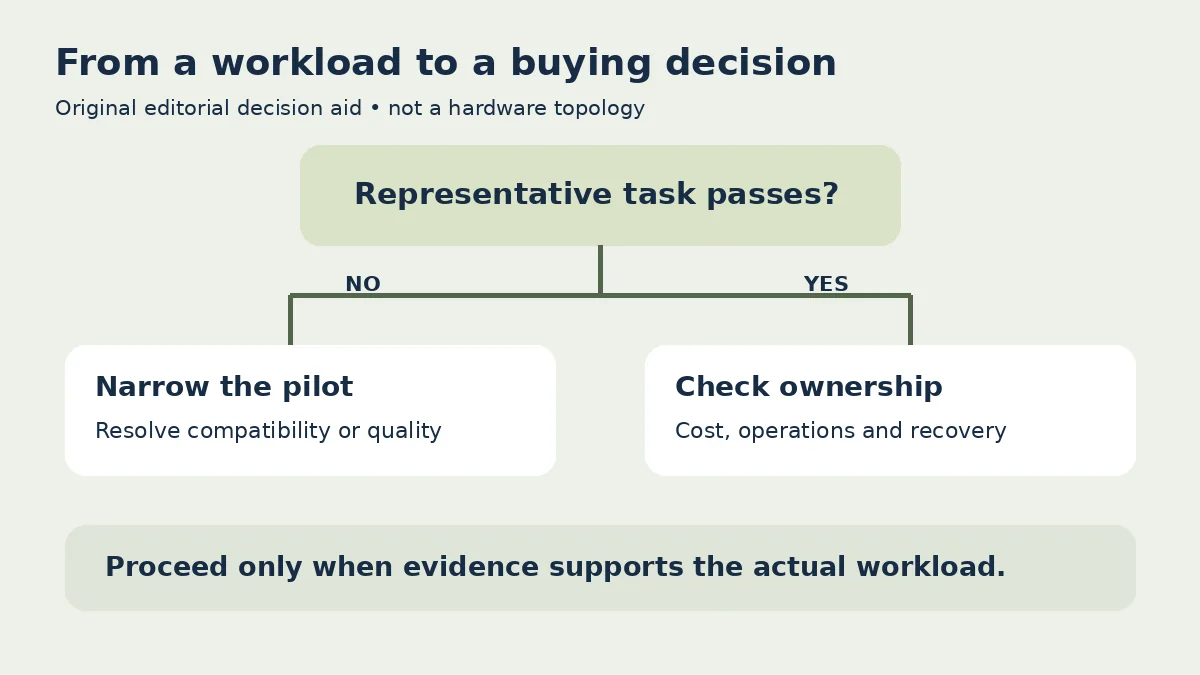
Start with a representative task rather than the largest model mentioned in marketing. Specify the input size, output requirement, number of simultaneous requests, and acceptable response time. Record whether the task is inference, fine-tuning, or another type of computation. Different workloads place different demands on the system.
Do not interpret combined memory across machines as proof that every application automatically sees one large memory pool. Ask how the chosen software partitions its work and what must move between nodes. The answer should come from the actual deployment plan and a successful test, not an assumption based on adding capacity figures.
Use a staged exercise: a small known case, a representative case, and a deliberately demanding case. For each, record whether it completes, whether the result passes your checks, and what resources it consumes. Keep the configuration fixed while comparing runs so changes have an identifiable cause.
If a compact model completes the real task accurately, a larger one may add cost without useful benefit. If a large model is necessary, confirm the desired quality under the exact settings you intend to use. A model fitting into memory is not the same as the application meeting its acceptance criteria.
4. Evaluate multi-node AI with an end-to-end test
Multi-node AI can add capacity, but the value depends on the application. Start with a working single-node baseline when feasible, then test the proposed distributed setup using the same task and validation method. Ask what additional configuration, coordination, and troubleshooting the second arrangement requires.
Measure the whole job: input preparation, loading, execution, transfer, and output checking. A short model-runtime number can conceal a long setup or data-movement step. Use the time that matters to the researcher waiting for an acceptable answer.
| Evaluation question | Evidence to collect | A reason to pause |
|---|---|---|
| Does the application work? | Reproduced reference output | Setup depends on an unverified workaround |
| Does distributing help? | Comparable end-to-end runs | More nodes add complexity without useful improvement |
| Can the team operate it? | Documented start, stop and recovery steps | Only one person understands the environment |
| Is the result dependable? | Quality checks and failure examples | Faster output fails the agreed checks |
Do not choose only favorable examples. Include a malformed input or an interrupted job in a controlled test environment. Record whether the system fails clearly and whether a colleague can recover it without losing the original inputs or confusing partial results with completed work.
5. Build an ownership-cost worksheet
No verified complete delivered price for your location and chosen configuration is established in this guide. Obtain a written quote that identifies the machines, networking components, support, applicable taxes, shipping, and any other required items. An advertised starting price is not a complete project budget.
Compare options over the same period and workload. Include purchase or rental costs, setup time, maintenance, electricity where relevant, backup arrangements, and staff time. For hosted alternatives, include the actual compute and storage arrangement you would use, not an unrelated headline rate.
An original planning formula is: total evaluation-period cost equals equipment or service charges plus setup, operation, support, and the cost of handling failures. Divide only after defining a meaningful unit, such as accepted experiment runs. Counting every generated answer equally can hide the cost of unusable output.
Run a conservative scenario as well as an optimistic one. Consider lower usage, extra maintenance, or a workflow that turns out to need a different tool. The purpose is to reveal which assumptions drive the decision, not to produce an impressive savings percentage from uncertain inputs.
6. Give local AI research an operating owner
Local hardware gives a team operational responsibilities. Name the person responsible for updates, access management, backups, and recovery. Decide where configuration notes and approved results will live. Write down how another team member can stop a failed job and restore a known working environment.
If an agent will use tools or connected services, distinguish model execution from permission to act. Running a model on your own machine does not automatically make an external action correct or authorized. Our AI agents and chatbots guide explains why an agent’s ability to take actions changes the workflow you need to supervise.
For a pilot, give the system a narrow task and limited access. Keep destructive operations and external commitments under appropriate human review. Our MCP tool security checklist provides related checks for connected tools. Apply the checks relevant to your actual setup rather than assuming every local experiment needs the same integrations.
Keep operational logs proportionate to the work. Record configuration changes, errors, and the version used for an accepted result. Those records help distinguish a model-quality issue from an environment change and make a future handoff less dependent on someone remembering the original setup.
7. Make the purchase decision reviewable
End the evaluation with a short decision record. State the problem, tested configuration, representative inputs, acceptance results, unresolved issues, and expected ownership costs. Separate measured observations from supplier statements and assumptions. A reader should be able to see why the proposed purchase follows from the evidence.
Three outcomes are reasonable: proceed with a defined configuration, narrow the pilot, or postpone. Postponing because essential software guidance is unfinished is different from rejecting the hardware altogether. Likewise, a successful demonstration is a reason to continue evaluation, not automatic proof of long-term reliability.
Agree on a review trigger if the team proceeds. A major software change, a new workload, or a recurring failure may justify another acceptance test. Preserve the original baseline so later decisions can compare like with like rather than relying on a general impression that the machine feels faster.
Frequently asked questions
Is DGX Spark HPC the same product as Rubin HPC?
No. NVIDIA’s announcements describe the Spark developer kit as a local multi-system setup and Rubin HPC as a separate future GPU. Their availability timelines differ, so evaluate them separately.
Does this guide provide a verified purchase price?
No. Request a quote for the exact configuration and location, including required components and delivery costs. Compare complete ownership costs rather than assuming a starting price covers the project.
What is the best first test?
Choose a small representative task with an answer or output you can verify. Record the complete process and acceptance result before expanding to a larger model or distributed configuration.
Does local execution remove the need for tool permissions?
No. Where a model runs and what connected tools may do are separate decisions. Define the allowed actions, review consequential steps, and check the data and services used by the pilot.
Should a team buy four systems immediately?
The right size depends on demonstrated workload needs. Establish a baseline and test the proposed configuration. Do not buy additional capacity solely because a larger setup appears in the announcement.
Use the announcement to frame a test
DGX Spark HPC is a reason to examine whether local development would improve a specific research workflow. Start with compatibility, accepted output, and operational ownership. A modest pilot with clear evidence gives a stronger basis for a decision than a specification comparison alone.